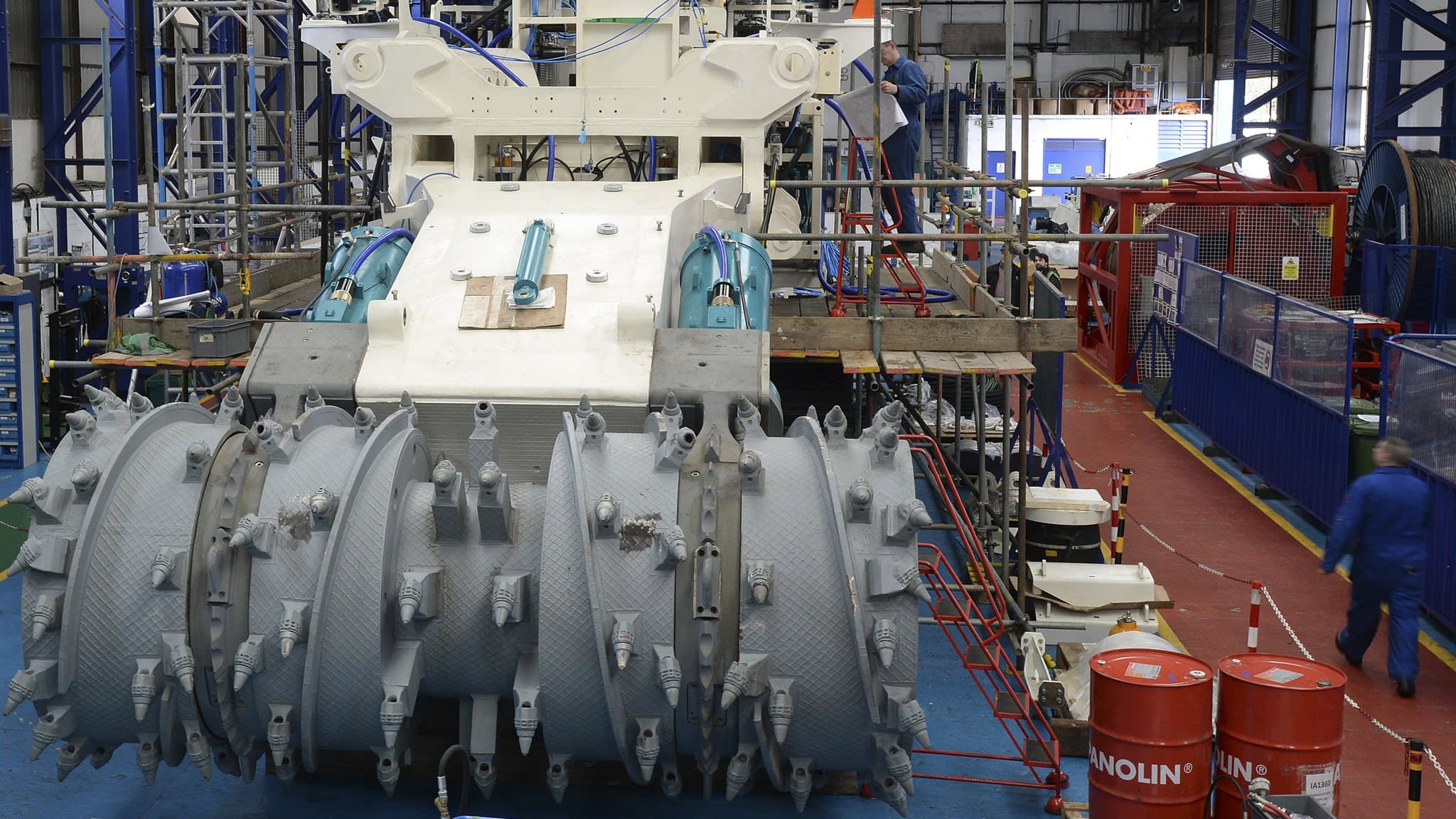
This is an example of a 15-minute speech on a technical subject that was previously unknown to me.
It was delivered in the House of Commons on 20 Feb 2019 in Westminster Hall (Hansard).
If you would like me to write a speech for you, please email me: [[email protected]](/web/20220520230145/https://andrewgadsden.com/cdn-cgi/l/email-protection)
The UK Deep Sea Mining Industry
I beg to move that this House has
considered the UK Deep Sea Mining Industry.
Introduction
I am grateful to the Minister for coming here to answer this debate today, because just a little political push – from her personally – over the next few weeks – might be all that our fledgling deep sea mining industry needs to succeed and catch up with our international competitors.
This is a timely and important
debate.
This year, we have reached a
critical point in the development of the UK’s Deep Sea Mining exploration and
exploitation capability.
A small push from her Department
this year could mean that the UK leads the world in environmentally-responsible
exploitation of vital and valuable seabed minerals. We could secure supplies of
the raw materials we need for a host of new technologies including rechargeable
batteries, as well as large tax revenues.
On the other hand, neglect or
bureaucratic inertia could mean that we squander a once-in-a-generation
opportunity and lose out to more agile and forward-thinking countries, such as
China and Belgium.
I want to briefly outline
- Why
Parliament legislated for deep seabed mining in 2014
- What
has changed since then – and the progress that other nations have made
- The
enormous benefits that this industry could bring to the UK
- And finally some things the
Government could do to help the deep sea mining industry to move forward.
Changes since 2014 Bill
Firstly then, Deep Sea Mining has come a long way since I took the Deep Sea Mining Bill through Parliament.
Back then, we were concerned with
making our law technically consistent with the UN Convention on the Law of the
Sea, or UNCLOS. Actual exploration of the deep Pacific seabed – let alone
exploitation – was uneconomic.
Yet Parliament recognised even then the enormous economic and strategic potential of deep-sea minerals, as well as the environmental risks. We recognised that the UK must be at the forefront of setting global standards in operating in these untouched and sensitive marine environments.
 Possible environmental impacts of deep-sea mining
In the last 5 years, technology has
moved on apace. Every year, seabed
minerals such as cobalt grow in importance. Demand for uses such as wind
turbines, solar panels and rechargeable batteries mean that the economics of
mining have totally changed.
The commercial opportunity and the
environmental risks are there right now. Other countries are well aware of
this. They have made good progress in building their industrial base to seize
the opportunity.
The International Seabed Authority,
the ISA, has said it wants to complete its regulations for mineral exploitation
“by 2020”.
So, we are no longer concerned with
legal technicalities and theoretical licences. This is happening right now and
the UK is falling behind.
Other nations have made strong progress
China, South Korea, Japan and the European Union – via Belgium – all have well-developed deep seabed mining industries.
China was just a side-player five
years ago, but since then, she has made great strides.
China now sponsors four deep seabed
mining contractors and has just applied for its fifth exploration contract.
That’s more than any other country.
During those same five years, we
here in the UK have sacrificed what was an enviably strong position.
*UK
was in a strong position *
When I brought the Bill through Parliament in 2014, Lockheed Martin told me that the UK was in a superb position to lead this industry, economically and environmentally, for the following reasons:
- Firstly,
our regulatory and legislative processes are transparent and predictable. That
is crucial for industry because it reduces their regulatory risk and allows
them to plan large, long-term, investments.
- Next,
we have high environmental standards and diplomatic leadership on maritime
issues.
- Thirdly,
we have a leading and central position in the offshore oil, gas and mining
industries
- Fourth,
we have a world-leading financial services industry
- And last but not least, we have an
international reputation for innovation and engineering and a track record of
solving complex engineering challenges.
*Raw
materials supply*
This really matters, because there are now strong concerns about the security of our national supplies of cobalt and rare earth minerals. China currently has a stranglehold on the supply of these minerals.
The UK is totally dependent on
imports for our supply of cobalt.
Cobalt is required for rechargeable
batteries for electric cars. As we all know, this is going to become incredibly
important very soon.
Both cobalt and rare earth minerals
are present in polymetallic nodules. The ISA has granted two licences sponsored
by the UK. The area covered by these licences is 133,00 square kilometres,
roughly the size of England. The current best estimate is that this area of
seabed contains almost one billion tonnes of minerals.
 Polymetallic nodules contain valuable metals, such as cobalt, nickel, and manganese
Nickel and manganese are vital for
the so-called “decarbonisation” agenda – for electric vehicle batteries and
wind farms. Unless we secure supply of these minerals we will have no hope of
meeting the terms of the Paris Agreement.
After just one deep-sea mining
operation, we would go from being a 100% net importer to a net exporter of
cobalt, nickel, manganese and rare earth elements.
Deep Sea Mining would allow the UK
to secure its own supply of all of these important minerals. Yet through
inaction we are letting China and other countries beat us to it.
*Battery
Science leadership*
The frustrating thing is that the UK has incredible, world-class expertise in battery science. Two years ago, this Conservative Government launched the Faraday battery Challenge.
Yet we have apparently not yet made
the connection that, if we want to be world leaders in rechargeable battery
technology, we will need raw materials such as cobalt.
We simply do not have our own supply
of the required raw materials in place.
Environment
I want to turn now to the importance of high environmental standards in this new and international industry.
It’s very important that the UK
becomes a leader in this field so that we can make sure that high environmental
standards are followed.
This is especially true, since the
USA has not ratified UNCLOS and therefore cannot participate.
We can lead not just technologically
but also in ensuring high environmental standards.
Other nations might not have the
same commitment to the environment that we do in this country.
There is a kind of gold rush
underway, and just like other gold rushes, proper environmental scrutiny could
easily be neglected.
The ISA has issued 26 different permits for mineral prospecting of which two are British-sponsored. The total area of seabed licensed by the ISA is now a massive 1.2 million square kilometres. The seabed is a largely unknown world and new species are being discovered that exist nowhere else. It is one of the last untouched ecosystems in the world. It is vitally important that the UK leads the world in setting the standards for exploration and exploitation without ruining yet another ecosystem.
 The Clarion-Clipperton Zone
Funding
The two UK-sponsored licences were both granted to UK Seabed Resources Limited, a wholly-owned subsidiary of Lockheed Martin. Lockheed Martin drew up charts of the Pacific seabed nodules in the 1970s, when exploitation was completely impossible. You might think of them as almost literal treasure maps. These charts now form the basis of exploration and eventual exploitation.
Needless to say, both of these
phases require significant investment.
Belgium benefited from EU funding.
Unfortunately the UK chose not to apply for that funding.
Up until now, Lockheed Martin has
self-funded, but in view of ongoing regulatory uncertainty has been obliged to
slow the rate of investment. It is worth noting that the other projects in the
Clarion-Clipperton belt have received financial investment from their respective
Governments which is a major reason why these projects are well-advanced.
Exploitation of these licences needs
to reach the pre-feasibility stage by 2022 and this will require fairly
significant funding. If we are not to fall behind further, Government funding
would be highly desirable so that at the very least the UK is not disadvantaged
compared to competing nations.
It’s worth noting that this funding
will not go to UK Seabed Resources itself but to the universities and other
regional partners who will conduct the research once funded.
Total investment for a seabed mining
project is very significant indeed – perhaps as much as £3 billion pounds. This
is about the same amount as for a similarly-sized onshore mine, but the level
of technical risk is higher, which is why some element of Government
involvement is normally required. The funding would not be all at once, but in
several smaller chunks.
Furthermore, only about £400m pounds
is required to reach the so-called “bankable feasibility phase”. At this point
traditional debt finance becomes readily available.
*Commercial
and tax revenue opportunity*
So this is an energy security issue, and it’s an environmental issue and it requires large investment. Next, I want to address the huge commercial and tax revenue opportunity it presents.
David Cameron, when he was Prime
Minister, called Deep Sea Mining “a £40 billion pounds opportunity”. This was
almost certainly an over-cautious estimate.
Of course, if we
invest in this industry and make it a commercial success, there will be a
benefit to the Exchequer. This will be in the form of both tax and royalties.
The current estimate
is that the Treasury will take £5.7 billion pounds in tax plus £360 million
pounds in royalties over 25 years. That is about £2.8 billion pounds at net
present value, given the Treasury’s 3.5 percent discount rate.
What we need to do now
I have tried to show that a new UK Deep Sea Mining Industry would create huge commercial, environmental and tax revenue benefits for this country.
Now I would like to address some
simple things that I believe the Government could do that would have a huge
impact on the prospects for this fledgling industry.
So I would like to ask the Minister,
firstly, in general what steps the Government has taken or plans to take to
pioneer this new and essential industry.
Specifically, how does she plan that
we will we catch up with competitor nations – and get back to where we should
be – in front – leading the way with engineering and environmental standards.
Secondly, what assessment has the
Government made of the risk of the UK’s and our allies’ economic reliance on
imports for minerals such as cobalt, nickel, and manganese.
Thirdly, what is our strategy to
reduce or mitigate these risks.
Fourthly does deep seabed mining
forms a part of that strategy? It’s now more than 4 years since we passed this
Bill into law but we don’t have a strategy or regulatory framework.
Turning to academia and business:
how could the Government support a research programme? Can we put together a
research programme, for example through the Industrial Strategy Challenge Fund,
to make UK academia and SMEs world leaders in seabed mining? If so, how?
As I have tried to stress already,
the benefits would be rapid and large, in the form of minerals supply autonomy
and environmental leadership.
Finally, can we explore avenues for
international cooperation, for example with the USA?
Other nations are looking to us to
show leadership in this field, and as we look outwards beyond Brexit, it is my
sincere hope that we will rise to this challenge.
Conclusion
In conclusion then, I have tried to show how the world has changed since the Deep Sea Mining Bill passed into law.
I have explained what an enormous
opportunity we have before us. We can ensure our minerals security, our
environmental leadership in this new industry, and gain massive benefits for
our industry and the exchequer.
But we are falling behind, and for
want of a tiny push by Government, we are in danger of squandering a
once-in-a-lifetime opportunity.
I would like to end therefore by
urging my RHF the Minister to look for ways that she can drive this fledgling
industry forward.
This is a new, challenging,
difficult task: the kind of task that the UK is uniquely capable of delivering.
But our capable officials need political will, determination and leadership if
they are to make progress.
I urge the Minister therefore to
work across Government to ensure that the UK does not miss this generational
opportunity to pioneer a new and essential industry with potential huge
benefits to the environment, to our energy security and to the Exchequer.
If you would like me to write a speech for you, please email me: [[email protected]](/web/20220520230145/https://andrewgadsden.com/cdn-cgi/l/email-protection)
var td_screen_width = window.innerWidth;
Andrew Gadsden
20 February 2019